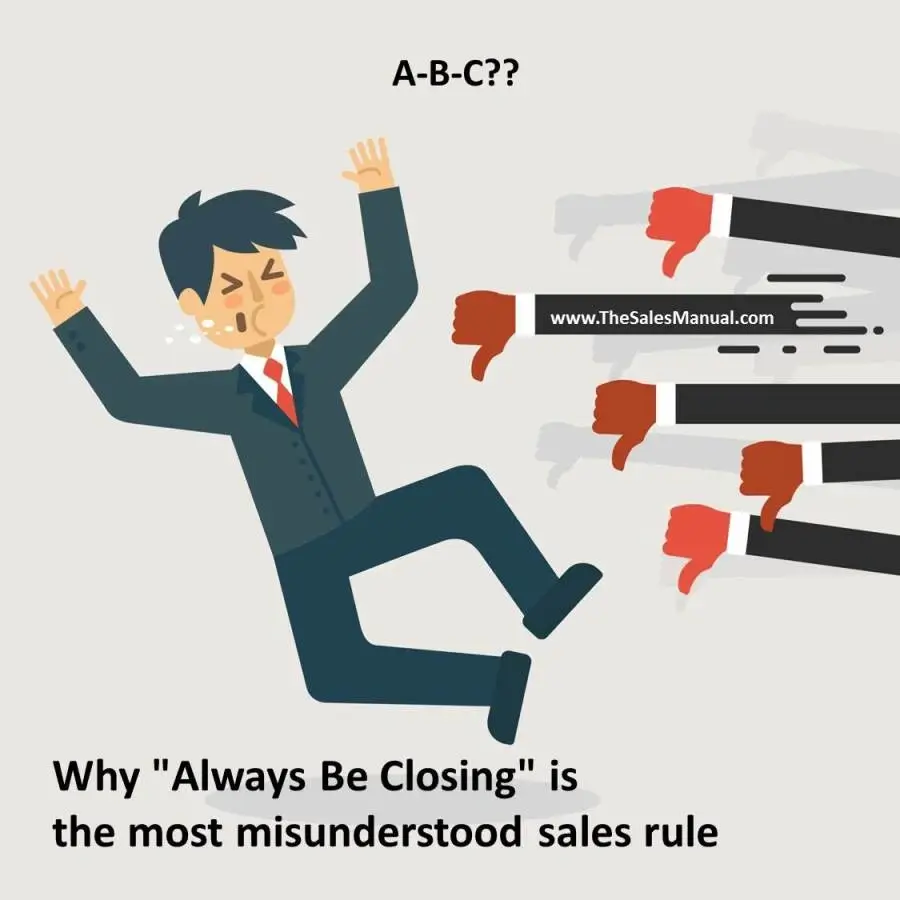

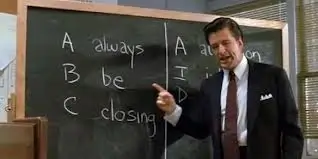
Whoever has a vague idea of sales will quickly associate the letters “A-B-C” with “Always Be Closing”. It’s a classic sales phrase which means “keep asking the customer to buy” (We give you 12 reasons why in THIS POST). If you have ever watched the movie Glengarry Glen Ross you will always remember the scene where Alec Baldwin stands in front of the blackboard using this powerful mnemonic to motivate his team to sell. However this post argues that Always Be Closing is the most misunderstood sales rule.
Why is it misunderstood? Because The Sales Manual believes that a one-size-fits-all Sales methodology does not exist. In the context that Alec Baldwin explains it “A-B-C” is totally valid, particularly if the Sales Cycle is short, or if the Sales Model is simple, or if there is only one, single decision-maker. But what if the Sales Cycle lasts a few months? a year? What if the decision requires various stakeholders to reach a consensus? Who do you “close”? What do you close them on? – “Would you like your fleet of fighter jets in camouflage blue or arctic grey?” Maybe not….
In long and complex B2B Sales Cycles you probably won’t get very far repeatedly asking directly for the deal (although it might be a risk occasionally worth taking if you’ve got sufficient charisma), but that doesn’t mean you shouldn’t ask for it indirectly via a subtle trial close. It’s in this context that A-B-C is misunderstood. Who says A-B-C means offering the Prospect a pen and asking them to sign a purchase order? If you’ve ever bought a car, did you get offered a test drive? That was a close. If you’ve ever bought clothing, did they ask you to “try it on for size”? That was a close. A free trial of anything for 30 days? No-commitment experience of the product or service is….. a close.
So what does A-B-C really mean? What the above examples illustrate is that even in the short and simple sales cycles “closing” is actually a way of nudging the Prospect closer and closer to a commitment by a series of small, innocuous steps or “trial closes”. Here are some more examples for B2B sales. You’re still closing, but you’re not directly asking for the purchase order.
“If we were to reach agreement, when would you prefer delivery?”
“What have you tried and discarded as a solution?” (follow up: “From what you know of our offering, would those same criteria apply?”)
“If we went ahead, when would your people be available for user training?”
Unfortunately A-B-C has been demonized as symptomatic of aggressive salespeople thanks to job advertisements such as “hard closers needed” and movies like The Wolf of Wall St and The Boiler Room. Many people have had this perception further compounded by their regrettable personal experiences with unscrupulous salespeople (timeshare? insurance?…). However, that does not invalidate its use, it simply means that you have to close professionally and with integrity.
Always Be Closing does not have to be the most misunderstood sales rule if you take these follow-up actions:
- Analyse your sales process – is it simple or complex? Short or long?
- Deconstruct your sales process – what could you ask the Prospect to do that does not constitute actually signing a purchase order but moves the deal forward?
- Go over sales you have won and lost – how did you ask for the business? What works and what does not work?
Follow me: