
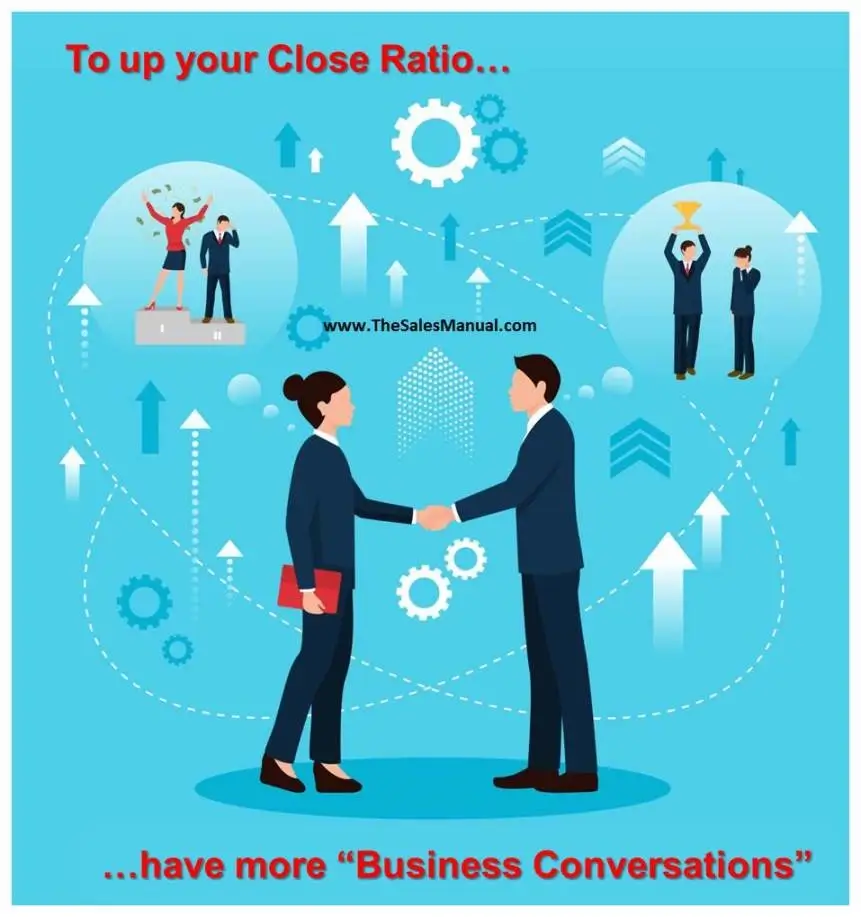

How often do you meet up with a Customer or Prospect for a coffee or an after-work beer? Just to “check in” with them? Or to find out “how things are going”? What kind of conversations do you have when you frame the meetings in that way? How much do you get out of these conversations? What is your expectation when someone invites you to “check in” with them? Are you expecting a business conversation, or just an informal 20 minutes “shootin’ the breeze”? Think about it carefully, because if your Contact does not have the expectation of a business conversation, then you probably won’t be having one, and you should change your sales strategy.
In B2B sales managing a deal to its successful conclusion is generally achieved through a series of business conversations, however brief some of them might be. In fact, if you don’t discuss business issues, it is unlikely that you will make the sale, so the more frequently you have this kind of conversation, the more you will sell, and you will improve your close ratio.
Why the distinction between “business conversation” and “conversation”?
Because a business conversation increases the probability of making the sale due to the issues discussed, which should be relevant to the progress of the opportunity you are working on. Why is that? What’s the difference between a business conversation and any other conversation? The difference is that a business conversation tends to focus on metrics that matter to the business, and these are what drive the sale.
SMART BUYERS DON’T WANT BUSINESS CONVERSATIONS
Smart buyers understand this perfectly well, because they try and design their Procurement Process to exclude business-oriented conversation. Typical examples are invitations to tender and RFPs, which try and reduce your Sales Process to a clinical technical analysis. Do you recall how difficult it is to have a business conversation once the clock starts running on an RFP?
YOU’RE DOING WELL IF:
You talk about the Prospect’s business model, how they see themselves in their sector, their competition, their business drivers and the latest trends in your respective markets. You will know you are in a business conversation if your Contact talks about the business outcome of the solution you are offering, or the metrics they will use to gauge the success of the project. If this isn’t what you generally talk about with your Customers and Prospects then you’ll probably have trouble selling anything.
YOU’RE DOING BADLY IF:
The dominant conversation topics are what you would talk about with your friends. Stuff like the ball game, the weather, company gripes and groans won’t get you closer to the sale. You should also avoid lengthy discussions about technical characteristics, and how stuff works. Relationships are important but results more so, so leave this stuff till the end, when you’ve got the business points resolved.
HOW DO YOU GET INTO THIS SITUATION? Non-business conversation tends to happen if we get lazy and keep going back to see the “usual contact”; if we accept ambiguous and cryptic replies instead of continuing to probe; or if we are simply too scared to ask tough questions.
HOW DO YOU GET TO HAVE MORE FREQUENT BUSINESS CONVERSATIONS? The indispensable condition for having a business conversation is to find the correct Contact. Not every person in their company will be able to comply. It has to be someone who actively participates in decision-making, rather than just recommending; someone who identifies problems to solve, not someone who is given problems to solve; someone who has a vision of the business, and not just of their own department. And if you insist on “just checking in”, pre-agree a mini agenda, even of just one small topic, which is oriented towards advancing the sale (see also Every Sales Interaction Must have a Clear Objective)
With whom do you normally meet? What is the typical content of your conversations? Business objectives and market trends? Or products and features? Be honest with yourself – do you need to change anything?
Follow me: