

SALES HUNTERS VS FARMERS
Within our own special world of Sales and its terminology we tend to divide Salespeople into two groups: The Hunters and The Farmers. The Hunters are frequently considered as the Rock Stars of the business. They are the front-line soldiers, the Road Warriors. They bring in new logos and are responsible for the continued organic growth of the business. The CEO will know all the good ones personally and the winner of President’s Club will be publicized around the whole company. It can be a very glamorous and highly paid role if you do it well. Compare that image with the Farmers. The dull name says it all. These are the Key Account Managers, or KAMs. They maintain existing accounts and to a certain extent only get a mention when a Key Account is lost. In fact, many companies do not have a strategic plan for Key Accounts, other than “sell them extra stuff, make sure they renew, and be on top of their support calls”. If that is the case in your company, you are probably leaving a lot of money on the table, because renewals and revenue are not the only metrics. Read the rest of the post that follows and then ask yourself how healthy are your Key Accounts?
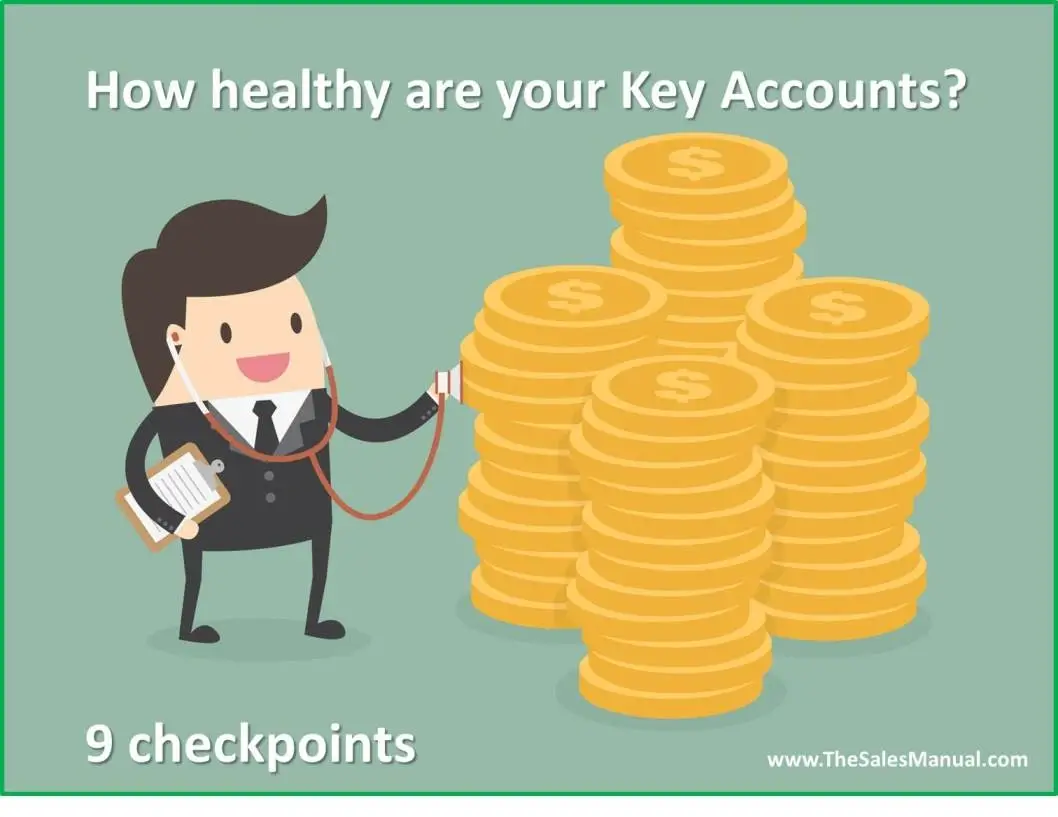
To state the obvious, the major advantage of a Key Account is that you are an approved and trusted supplier. This doesn’t only mean a lower cost of sale for you, but also a lower cost of sourcing for the Customer, so help them amortize it by creating a plan to strengthen and broaden the relationship as much as possible. Use these 9 checkpoints as a structure for growth.
1 – Is the Key Account profitable?
It is not unusual to have to bid very close to break-even when acquiring new business, especially for high value transactions and very large Accounts. That being the case, at what point does the Key Account become profitable? How much more needs to be sold?
2 – Have you agreed a relationship governance process?
Rather than “being there when they need you” and organizing the occasional lunch, create objective two-way communication of news and ideas through a formal weekly/monthly/quarterly governance process. All issues of the relationship can be identified and discussed through these meetings. Senior executives should attend the quarterly, strategy-focused meetings.
3 – How will you grow the Key Account?
Each Key Account is a market within itself, as if it were a geographic territory for a new business rep. In the same way you need to track down and create relationships with all the key influencers and decision-makers, and map the potential expansion Opportunities onto them. They are unlikely to come knocking on your door.
4 – How will they become a testimonial?
Solid testimonials from existing Key Accounts are expected by new Customers, so be prepared. Don’t fall into The Testimonial Trap and end up selling your soul (and trading profitability) for a single visit or phone call. Start the process off on Day 1 of your tenure by asking why they bought and are those reasons still valid?
5 – How can you mutually benefit from co-marketing?
The best testimonials are not testimonials at all but explanations of how the Customer’s relationship with the supplier helps them keep ahead of their competition. If you don’t have that yet refer to the testimonial text in #4 above to develop a thread with business metrics and publish it wherever and however the Customer agrees to it, both internally and externally.
6 – Do you participate in marketing events?
Take that co-marketing one step further and develop a marketing initiative where you mutually promote each other. Examples could be executive speaking slots at trade shows, webinars or user group meetings.
7 – How strong are the C level connections?
If the respective leadership teams have regular and direct contact the relationship has a much stronger chance of developing and you, as the KAM, could find the occasional surprise purchase order on your desk. Are you making this happen?
8 – Do they participate in beta testing?
Just as we all appreciate an opinion from people we know and trust, every vendor needs a beta community to test its offerings before general release. Engaging your Key Accounts in feedback in this phase of your product development makes the relationship stronger and increases the chances that they will buy and use it – after all, their ideas are included!
9 – Do you have a Customer Advisory Council?
The ultimate step. Your Customers are not just engaged at a tactical (product) level, but are advising and supporting you with respect to how you should evolve as a company.
How many of these initiatives do you have in action right now? If you took their temperature today, what would be your response to the question: “How healthy are your Key Accounts?”
Follow me: