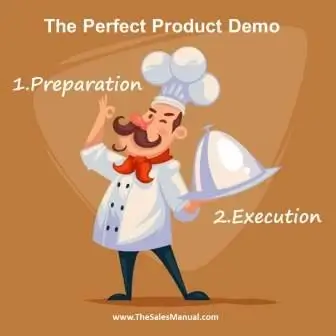

Do you sell a physical product (let’s include software in this category)? Does your sales process require a product demonstration? If so, remember that the use of a demo has been an integral part of the sales process for decades, and if you want a good example of how to do it then you need look no further than the “TV Chef”. Like him, we divide the perfect product demonstration into two phases
1. HARD QUALIFICATION
Before a real TV show is aired there is an entire market research team that makes sure that this show, aired at this particular time, will be relevant and interesting to the likely audience. You and your presales colleague must do the same by hard qualification. Before you even agree to do the demo, you should ask yourself three essential questions:
i) Is the audience relevant?
How will these people influence the decision to buy? Are they ready for change? Can they get budget for my solution?
ii) Is the content relevant?
Many buyers are experts at getting a salesperson excited just by agreeing to move to the demo stage of the process, so always ask: “What specifically do you want to see and why?” The TV Chef shows how to make the lasagna, not Italian food in general.
iii) Is the message relevant?
Decision-makers and users have different needs, so prepare your demo routine with that possibility in mind – even be prepared to do two different demos if necessary – a meat lasagna and a vegetarian one.
2. EXECUTION

Just like a TV program, doing a demo is pure theatre, so prepare to show your offering in its best possible context and follow these 5 rules:
i) Use a screenplay and stick to it
Your demo should have a screenplay: fully rehearsed; entertaining if possible, and understood by the players (you and your technical expert). Any improvisations should be “planned”! If they want to see another product or anything that falls outside of the demo screenplay, politely suggest another meeting (if the Prospect is serious, they’ll take it).
ii) Start with the desired outcome
The TV Chef doesn’t show the wheat being transformed into pasta, the tomato seeds being planted and then picked, etc. He starts with the completed, perfect product, fresh out of the oven, because that’s what he’s selling, the completed, perfect product. That’s the approach you should take with your demo – start with the desired outcome you have pre-agreed with the Prospect (if you did not do that, what’s the point of the demo?) and then show how you got there.
iii) Show how you get there, but not in infinite detail
Show how a product would be used, but without being a full-blown training session. Our TV chef will always show all the keys steps of preparation but, has a time limit so he frequently moves to vegetables already chopped, cheese already grated etc. If the lasagna needs 45 minutes in the oven he won’t force us to look at the oven door while it is inside cooking, so don’t do it to your demo audience. Find a way to skip over all time-consuming aspects of set-up, implementation, etc and concentrate on how you solve their problem.
iv) Let them try the product
Trying the product substantially increases your emotional attachment to it and the likelihood of buying it, so you should get your Prospect to do the same, even if it is just making a few clicks with the mouse. The TV chef always tastes the lasagna and…. wow! that tastes good!
v) Finish with a call to action
And then they cut to to the adverts and…. you can buy the recipe book, visit a well-known supermarket where you can buy the ingredients, etc. That’s their call to action. Yours should be a summary of what you’ve shown, how it solves the prospect’s problem, and agree next steps with the their procurement process leader (a paid trial, SoW, configuration and price agreement, etc).
FOLLOW UP: 3 action steps to take now:
- Review your qualification process – do you ever do demos just because the customer asks you to?
- Create your demo screenplay. Make sure your presales colleague is on-board with it.
- Think about how your Prospect can try out the product during the demo
Follow me: