
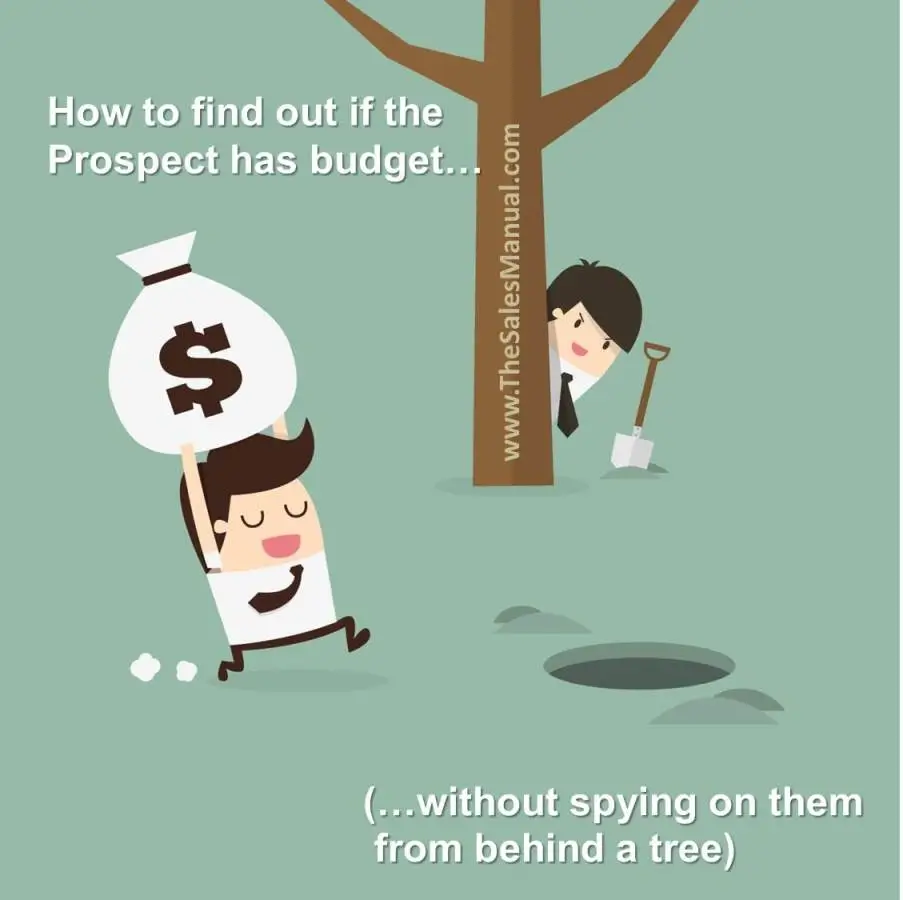

….without spying on them from behind a tree.
“We’ve got no budget”. How many times has a Prospect told you that? Now you have a decision to make. Do you continue in the Sales Process, knowing that there is no money available to purchase your offering? Or do you go back to your Sales Manager and tell him: “This one’s dead, take it off my forecast.”? How will that go down? It’s a tough call if your job is to find new business.
IT COULD BE TRUE
Realistically, a company can be on the verge of going out of business, in which case “we’ve got no budget” is not merely an objection or negotiating tactic but a real showstopper, and so you have to take the statement seriously (unless you are a lawyer who can help them stave off bankruptcy). However, more often than not it’s a bluff which the Prospect will use until you can credibly demonstrate the contrary. Either way, before you pursue a lengthy and costly Sales Process it makes sense to find out if the Customer has the money to pay for what you are selling.
How do you do that? Read on.
WHAT DOES “NO BUDGET” REALLY MEAN?
Most companies have got money to spend on fixed costs – the stuff they have to finance before they make a single dollar in sales. They spend it on salaries, bank loans, office rental and associated utility bills, mobile phones, etc. If they don’t have money for fixed costs then they probably don’t have budget. However, when your Contact says “no budget” it frequently means insufficient allocation from the available finance which is agreed and shared between departments at the beginning of the financial year. Money is available inside the company, but just not to your Contact unless they have solid justification, which it is your job to give to them with a compelling value proposition. Even so, every great value prop still needs money, and so you’ll need to do some detective work to help them (and not just by hiding behind a tree to see if someone is systematically hiding money in a hole in the ground):
YOUR PROSPECT GENERALLY HAS BUDGET IF
….they are hiring staff. Nobody hires staff without having a forecast or goal of increased revenues.
….they are firing staff. Reducing headcount is a classic method of converting fixed costs into funds to reinvest in capital.
….they are winning new customers – no explanation needed.
….they are planning a new product launch.
….they move into new premises, which means either consolidation (freeing up cash from fixed costs) or expansion – both good.
….they are attracting venture or stock market capital.
….they are in a thriving business sector, in which case a rising tide lifts all boats (if they sell fax machines, probably not).
….they are the market leader (they got that way because they continue to invest) or an aggressive challenger (you need to invest if you want to be Nº. 1).
….they are in a traditional old industry sector, like banking, telecommunications or public utilities, where, although they may have the occasional problem, they rarely go out of business.
….they are a big, publicly quoted company.
….they are public administration (and you know where their money comes from – it comes from you!)
WHERE CAN YOU FIND THE INFORMATION?
ON THE PROSPECT’S WEB-SITE
This is your first stop. You should be all over these for all your Prospects. Every company wants the world to know that it is doing well – that’s how they attract top talent, get funding and give confidence to their customers and investors. If they are publicly listed they are obliged to publish an annual report which will tell you which areas are strategic for them. If your offering addresses any part of that strategy, they will find budget, even if they “don’t have it”. Go to the “Careers” tab and check out the type of people they are hiring. A predominance of customer facing roles is positive. “In the news” and “Press Releases” are also invaluable sources because they are approved by your Prospect and therefore uncontestable.
IN THE TRADE MAGAZINES
On-line or in hard copy, trade magazines are always looking for success stories (and otherwise) that feature their members or their members’ customers to attract readers and therefore ad revenues.
IN THE LOCAL PRESS
Just like trade specialists, they are a wonderful source of both real info and also gossip and rumors, some of which may be both relevant and true. You’ll pick up useful contact info here too.
ON SOCIAL NETWORKS
Individual posts, “I’m hiring” in job titles, and job adverts themselves (what roles are they hiring for?) all feature information in the public domain which you can collect and use to assess if a Prospect has budget.
ON BUSINESS DATA SITES
You may have to pay for premium subscription for a high level of detail but Crunchbase, AngelList, D&B Hoovers, Bloomberg and others offer a further perspective on a company’s financial health and its movements. Save them all in your browser, watch their TV channels.
Nobody will admit to having money, especially if you ask straight out, so collecting all this information in advance will help deal with that gambit when it occurs. On the other hand, if it turns out that the Prospect genuinely does not have and will not have budget, you can confidently qualify out, save yourself some heartache, and demonstrate to your sales leadership that you did your homework.
FOLLOW UP ACTIONS
In case you missed them:
- Pay weekly visits to your Prospects’ web-sites and be the first to pick up the news
- Follow your Prospects and their key employees on the social networks
- Save business data sites, trade press and local press in your web browser and set up alerts for your Prospects
- Get from behind that tree
Follow me: