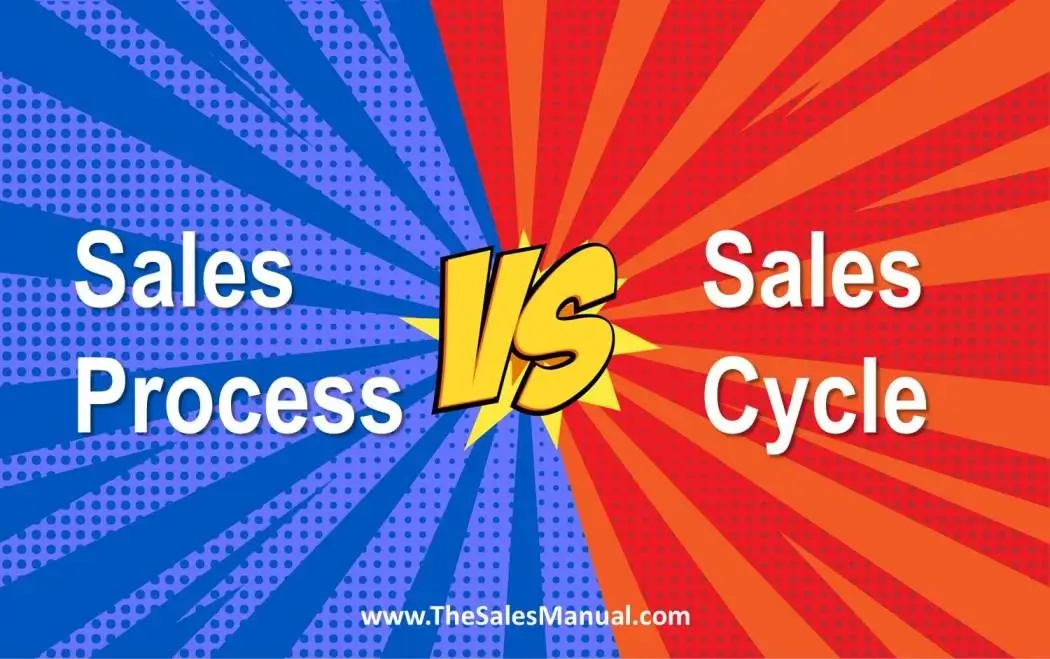

During recent sales training sessions conducted by The Sales Manual we have detected a distinct confusion amongst delegates between the terms Sales Process and Sales Cycle. These terms cannot be used interchangeably, so in this post we address the difference between them.
What is a Sales Process?
A Sales Process is a series of stages that a Salesperson follows to take a potential customer from the early stage of awareness or enquiry (Sales Lead) to a closed sale. Think of it as a potential customer’s journey from realizing they have a need for a product to making an actual purchase. By definition, if the Sales Process is a journey for a prospect, then it is a roadmap for a Salesperson to follow and take them to the desired destination. According to The Sales Manual, a Sales Process should consist of 5 stages: Prospecting, Qualification, Solution Agreement, Commercial Proposal, and Purchase Order, although some companies prefer to add others (which in our opinion makes selling a little too complicated).
The objective of having a Sales Process is that, designed correctly, it will optimize your chances of making the sale by automatically bringing out the unique selling points of your offering. It also creates a uniform sales approach across the company and thus brings two advantages to Sales Management: 1) It can be directly mapped onto the company’s sales forecasting system and used as revenue guidance; and 2) Each stage can be refined, polished and integrated with the appropriate resources from the rest of the company (Business Development, Technical Presales, Legal, etc.,).
What is a Sales Cycle?
If the Sales Process is measured in stages or steps, the Sales Cycle is mentioned in time. Finding a universally acceptable definition of the Sales Cycle is not so easy. This is because many variations of the definition exist. Generally speaking, the Sales Cycle will encompass all activities from first contact to closing a deal, although some Companies don’t start the clock running until they feel the Prospect has “entered the Sales Process”. Regardless of the definition, however, businesses should keep track of the length of their Sales Cycle as a metric of Sales efficiency.
Of the two the most important in terms of HOW you sell is evidently the Sales Process. The whole point of having it is that it defines and controls how YOUR Company operates in the field. However, be aware that the Prospect does not have to agree. If you don’t have a Sales Process, then you will automatically follow the Prospect’s Procurement Process, which they will have designed to suppress differentials of the various offerings and create a price battle amongst competitors.
Do you understand your Company’s Sales Process? How many steps does it have? Is it mapped onto your Sales Forecast?
Follow me: