

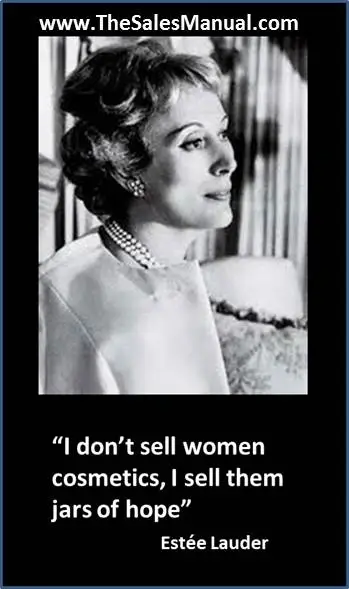
Do you really know precisely what you sell? Estée Lauder, the last great independent icon of the cosmetics industry once famously said, “I don’t sell women cosmetics, I sell them jars of hope”.
What do insurance companies sell you? Peace of mind. How about Rolex or Breitling, for example? A guarantee of punctuality? Or luxury and prestige? These companies don’t talk in terms of individual products and their characteristics but about a solution. When you sell a drill, what you are really selling is the holes that it can make. As improbable as it may sound, a successful Sales Strategy does not focus on the product, but on the impact of its use.
In principle this idea flies in the face of conventional sales wisdom. Aren’t we supposed to explain our offering in terms of “feature-function-benefit”? No. Not if you want to differentiate yourself from the competition. There are 3 important reasons for that:
1. TECHNOLOGY
Technology is now moving so fast that products are released and improved at lightning speed. A feature or functional advantage for you today could be overtaken by your competitor tomorrow, and rendered completely irrelevant by a new market entrant next week.
2. BUYERS ARE INFORMED
With access to the internet today’s buyers have unlimited access to information on a virtually unlimited range of alternatives, most of which will differentiated by features and/or price. You need to sell value to have a chance.
3. YOU LOSE THE EMOTION
Selling features and functions enables the Prospect to make a cold, product-oriented decision which ignores the emotional aspect of the problem they are trying to solve – precisely the opposite of what you want.
HOW TO SELL THE HOLE AND NOT THE DRILL
a) Illustrate sector-specific use cases of your offering as an integral part of your Sales Process – “This is how we helped Company X – does that sound similar to your requirement?”
b) Focus on the Prospect’s desired outcome with intelligent open questions, instead of directing them towards the features of your product. If your drill can’t help the Prospect make the holes they want, qualify out.
c) Any solution you then propose should be agreed with the Prospect and based on that desired outcome. Don’t just present your solution and hope there is a need – that’s a waste of everybody’s time. A successful Sales Strategy focuses on the impact of use.
So have you decided? What will you sell from now on? The product? Or the impact of use?
FOLLOW UP: 2 action steps to take now
Introduce real customer use cases into your approach, preferably with specific results
Review how you qualify – are you focused on you or on the Prospect? Are you prepared to walk away if there is no clear need? (Read our post “The 5 Steps of Opportunity Qualification“)
Follow me: