
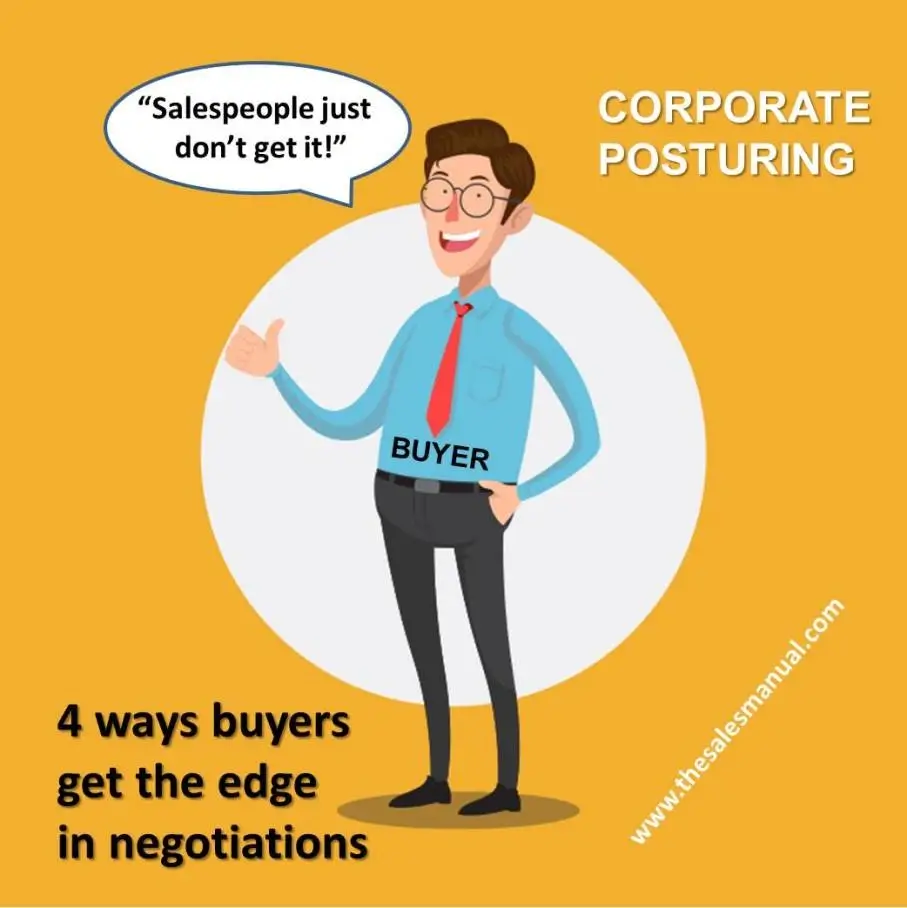

…..before a word has even been spoken
The best salespeople know that everything is negotiable, but that still doesn’t mean that they always negotiate effectively. The reason? Top negotiators (particularly the buyers) often get a helping hand from their companies so that negotiations start before Salespeople even realise, before the first word is even exchanged!
Excuse me? BEFORE you speak? How is that even possible?
It’s true. They use “corporate posturing” to set up the negotiation well in advance so that you, the salesperson, are immediately at a psychological disadvantage.
Here are 4 everyday examples of how big (and not so big) companies use corporate posturing to put their buyers in the driving seat before anything has been discussed.
Posture 1. Playing hard to get (to)
Those slightly out of town corporate campuses must be fun places to work, but they can be hell to visit. Slightly too far away to make a return taxi ride economically justifiable, frequently just out of reach of efficient public transport, and with a huge car park of 1000 spaces, only 6 of which are reserved for visiting salespeople, so they are frequently full. Oh yeah, and they are skilfully hidden in the corner furthest from the entrance, so you can easily lose 10 minutes parking the car and walking the 200 metres back to reception. As a result you arrive still thinking about the journey and not about your sales pitch. Just what the buyer wants in the first meeting.
MY TAKE:
Don’t worry about it, if you’re smart it will only happen once and not at all if you schedule to arrive 15 minutes early (see post).
Posture 2. You can have VIP membership
Let’s move back into the middle of town. You walk into a downtown Reception area with an imposing 40 foot ceiling, beautiful designer furniture, a permanent modern art exhibition in one corner, and attractive young staff fresh from a Dolce & Gabbana catwalk whose job is to announce you to your contact. This company obviously has money and prestige! Your friends and colleagues will be so envious if you can do business here! And that is exactly what the buyer is counting on, so that you will make unrealistic concessions in return for your VIP membership of their glamorous club.
MY TAKE:
Your priority as a salesperson should be to go to the bank, not boast about which companies you visit. Millions of reps have got rich by selling unglamorous products to unglamorous companies, giving them the money to pay for any VIP membership they like.
Posture 3. Your heroics will be worth the effort
Protecting intellectual property and staff is a serious issue but some mega-companies use this as an excuse to intimidate suppliers. Reception staff with batons and handcuffs? You have to give up your ID card/passport while you visit? You pass through an airport-style security check, with a conveyor belt for your back-pack and everything? An international telco even insisted on putting THEIR ugly, big-ass sticker on MY laptop “to ensure there are no mix-ups when you leave” (excuse me??). The whole “experience” is designed to humiliate the salesperson and destroy their self-esteem. Simply getting through to the buyer’s cubicle really makes you feel like a heroic warrior. The buyer, of course, knows this, and promises that “it will be worth it in the end”, “there will be plenty of business”, “if you prove yourself”. You feel grateful for the recognition, and once you’re in that mindset, the buyer can get a concession more easily.
MY TAKE:
Don’t be taken in by promises of riches and be rigorous with meeting times. You can’t control how long it takes to get through the doors of Bully Inc. but you can control the time you leave. Never be late for the day’s next sales visit because one’s customer’s security processes eat up the time you scheduled with their people. If there really is a deal for you they will make more time to talk with you next time.
Posture 4. If you want to play here, these are our rules
What started as a trend amongst HUGE multinationals to streamline and automate their purchasing processes for commodities has been converted into a corporate posturing best practice. Companies big and small now use their web-site to start negotiations early with salespeople by publishing their “non-negotiable” purchasing conditions and an occasional RFP. This could mean, for example: “if you’re not prepared to give us 60% discount, free training and set-up, allow us to pay you at 365 days from invoice, and all that with an unconditional money-back guarantee, don’t even bother calling us”.
MY TAKE:
One of my mentors once told me: “the prospect’s perspective of the price of a solution will always be conditioned by their perception of the cost of their problem”. Whatever the apparent rules are, every company has problems it needs to fix, and budget to fix them, regardless of the rules they publish on their web-site. It’s your job as a salesperson to work out how severe the problem is, and how much it’s worth to them to get it fixed.
If you apply this maxim to all four of the scenarios outlined in this post you will find that the corporate posturing of the buyer’s company has much less effect on your deal and you will end up negotiating more effectively.
Have you ever given a concession without the buyer pushing too hard? Do you think it was for one of these four reasons? Send me a Whatsapp message or email and tell me about it.
Follow me: