
Have you had the need to visit the Doctor lately? How did the conversation go? Was it something like this?
“Hi Ruth! How wonderful to see you! How’s everything going? How’s the family? You know what? It’s your lucky day! Right here in this tube is some cream you’re going to love, and I just had a delivery of these new pills that they tell me cure everything – everything! Hold on! You always need sticking plasters at home right? How about these colored plasters for the little ones? How many would you like to buy?”
Not like that? Let’s hope not!
After all, it would be unthinkable for a medical Doctor in modern society to prescribe medicines for a patient that were not strictly necessary. Not in a million years. Their principal concern is to check to see if you’re OK, that you DON’T have a health problem. And if you are OK, he tells you, and does not prescribe anything. However, this is exactly the opposite of the behavior of what many people would recognize as a “typical” Salesperson, trying to sell their offering, no matter what. So what’s the answer? The answer is to sell as if you were a doctor to build trust. So what does a doctor do that a Salesperson should copy?
A Doctor asks “Why are you here?” If the Salesperson and the Prospect are not spending time with each to solve a potential problem, then what’s the point? Why waste each other’s time?
A Doctor is credible as a domain expert in the patient’s physiology, which gives them the right to ask (sometimes) uncomfortable questions to get to the bottom of the problem. In the case of the Salesperson this equates to having an understanding of the Prospect’s business.
Before prescribing a remedy, a Doctor makes a diagnosis, based on information that their patient gives about their symptoms and the way they are feeling.
A Doctor then prescribes a precise remedy based on that diagnosis.
A Doctor accepts that there are perfectly healthy patients who will not need their services.
Does it make sense to propose a solution before precisely understanding the Prospect‘s (patient’s) problem? (the problem the Prospect recognises not the problem we assume/hope they have) or before verifying that they have the budget to pay for it? Or to propose something that you are pretty sure the Prospect does not need?
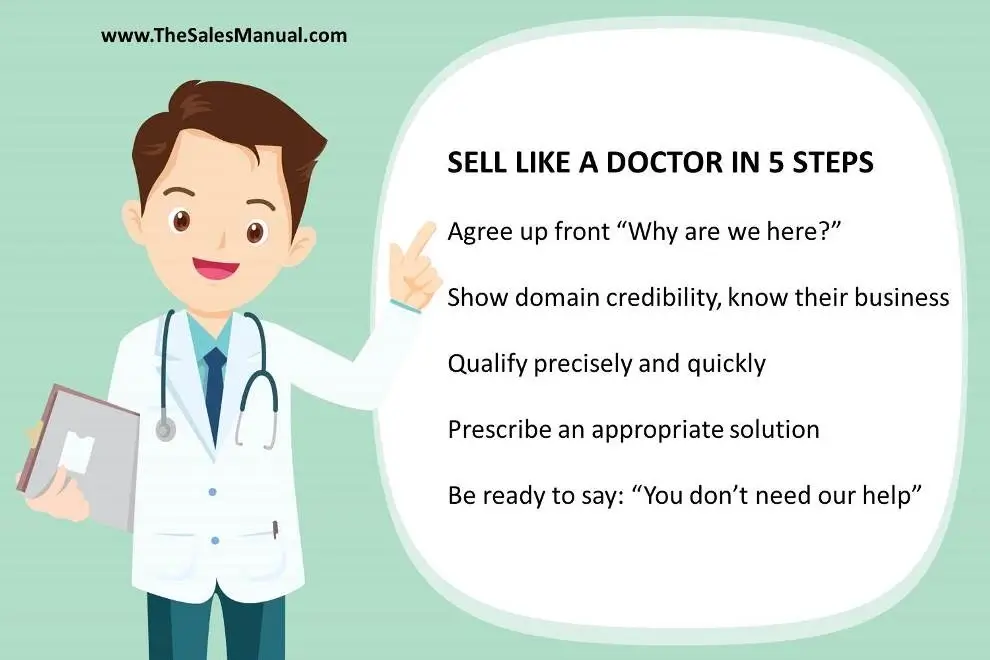
How to build trust with your Prospects by selling like a Doctor – follow these 5 steps:
- Agree in advance why you are meeting and what problem you can potentially solve. “Why are you here?”
- Learn about the Prospect’s business sector beforehand to establish business credibility. The Doctor does not expect the patient to educate him on the human condition, and you should not expect the Prospect to teach you about their business.
- Qualify (diagnose) well and quickly by precise questions that will help both of you understand the impact of the problem on the Prospect’s business.
- Prescribe an appropriate solution for the problem you identified together, (not for all the possible problems they could have).
- Be prepared to say: “You don’t need our help” so that you can part as professionals and speak again at a more appropriate moment.
Follow me: