
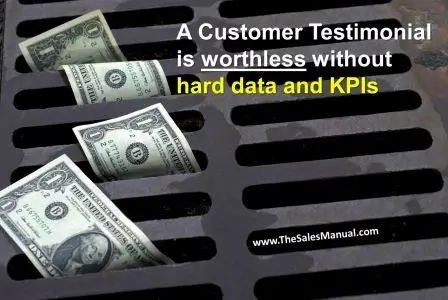

Customer Testimonials are good to have.
They give social proof, validating both your value proposition and your company as a supplier. They also guide Prospects towards your offering’s most loyal and successful users, reinforcing it and helping you to shorten the Sales Cycle. But they need to be rock solid, otherwise, you’re just throwing money down the drain.
IT’S EASY, RIGHT?
Like most things in Sales publishing a Testimonial just seems so easy to do, right? Whether it’s for your web-site or a datasheet it just appears to be a matter of calling up Customers until you find the ones who are satisfied, drafting up what they say, and, subject to their approval, putting it out there. What could be easier? Well from the testimonials we see, just about everything, because most of them are absolutely worthless. Why? Because they do not contain hard data and KPIs.
TOO HARSH? NOT CONVINCED?
Let’s consider a couple of examples, one bad, one good.
Example #1 – The Worthless Testimonial
You can find rubbish like this all over the web and it probably doesn’t convince the vendor’s own Salespeople, never mind a prospective Customer. We won’t name and shame, however, so we’ve just repeated the typical text in our examples.
“I would not hesitate to recommend the Acme Services Co. They supported us throughout the whole process, their Consultants know their stuff and their solution satisfies our needs” – Project Manager, a medium sized company
HARDLY ROCK SOLID
Didn’t they expect support throughout the whole process? Did they expect less than expert Consultants? Were they prepared to buy a solution that did not satisfy their needs? This Testimonial gives you no data whatsoever that can be used to validate the solution or the company.
Should we add other frequent Testimonial phrases like “Their Support was first class” (why wouldn’t it be? and how do you define “first class” anyway?)? or “We never had a single problem during implementation” (that’s a relief! was that a worry before they bought?)? Or how about a well-aimed bullet to the foot with “They were able to meet our budget” ?!!! You can hear the vendor Salespeople sobbing and banging their heads against the wall at this very moment: “They’ve told the market we’ll negotiate prices!!”
Example #2 – The Sales Manual Testimonial format
“The supply chain solution of Acme Technologies helped us to reduce raw material costs by 37% in the first 6 months of use, without having to sacrifice product quality. This has helped us be more competitive and expand into new markets.” – Tony Stark, CEO, Stark Enterprises Inc, (biotech research leader)
WHY IS THIS TESTIMONIAL BETTER?
1) Credibility
Who said this? One of the Customer’s 50 Project Managers? An office admin intern? No! The CEO! His approval of a supplier is the best you can get, and other CEOs will take notice.
2) Context and relevance
The company is named (their profile can be researched for further detail) and the industry is stated, giving the Testimonial immediate relevance to a defined group of companies.
3) It refers to a specific solution
Do you know what the Customer bought? Absolutely! If you were looking for supply chain technology, you know you can find it here.
4) Hard data and KPIs
“37% cost savings”. “in a 6 month time-frame”. Now they can “expand into new markets”. This is the icing on the cake. Not a wild claim from the vendor, but real business results, substantiated by the CEO of a Customer. Who wouldn’t be convinced by a Testimonial like this?
HOW WOULD YOU RATE YOUR COMPANY’S TESTIMONIALS?
Which of the two examples do they resemble most? How close are they to worthless? If you would like to develop worthwhile Testimonials with hard data and KPIs you’ll need to start early in the Sales Process. The following Sales Manual posts will explain how to do that (or you could book a call with Phil HERE if you’d like to find out how to get a solid testimonial from 20% of your customers):
Reference/Referral or How to easily find New Business Prospects
A successful Sales Strategy focuses on the impact of use
The 5 steps of Opportunity Qualification for any Sales Process
The Testimonial Trap and how to avoid it
Include these two KPIs in your sales proposals to boost sales
Follow me: